Cinnamon: A Review on the Medicinal Plant and Its Health Benefits
Prachi Bansal
*

Department of Vikriti Vijayan, Faculty of Ayurveda, Institute of Medical Sciences, Banaras Hindu University, Varanasi, Uttar Pradesh, India.
Vanshika Bansal
Central Leprosy Division, Ministry of Health and Family Welfare, Nirman Bhawan, New Delhi, India.
Anuradha Roy
Department of Prasuti Tantra, Faculty of Ayurveda, Institute of Medical Sciences, Banaras Hindu University, Varanasi, Uttar Pradesh, India.
A.C. Kar
Department of Vikriti Vijayan, Faculty of Ayurveda, Institute of Medical Sciences, Banaras Hindu University, Varanasi, Uttar Pradesh, India.
*Author to whom correspondence should be addressed.
Abstract
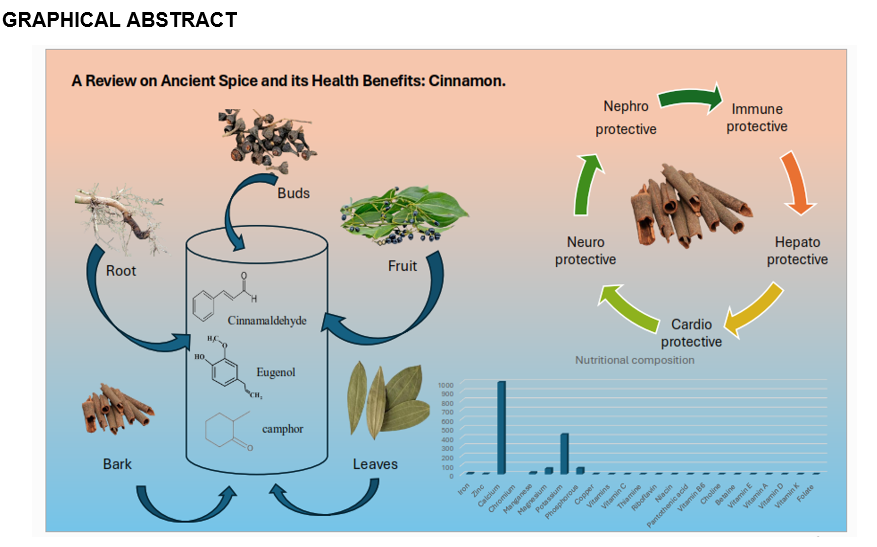
Cinnamon is a spice used daily by people as a traditional medicine for centuries all over the world. It is an evergreen plant, and its leaves and bark are good sources of oil. It belongs to the family of Lauraceae. The main species of commercially cultivated cinnamon are Cinnamomum verum, Cinnamomum burmannii, Cinnamomum cassia, and Cinnamomum loureiroi. The objective of this review is to discuss the uses, chemical composition, nutritional composition, toxicity, and the potential role of cinnamon in overall health management. For this review, extensive bibliographic research was conducted, utilising keywords such as its uses, chemical composition, nutritional composition, health benefits, and toxicity. Key findings conclude that cinnamon possesses antioxidant, antimicrobial, anti-diabetic, anti-inflammatory, Insecticidal, anti-tumour, neuroprotective, nephroprotective, anti-obesity, cardioprotective, anti-hypertensive, anti-allergic, hepatoprotective, immunomodulatory, and gastroprotective properties. Moreover, the nutrient composition revealed that it is a great source of dietary fibre and minerals. This review focuses on summarizing the most relevant literature to highlight the health benefits of cinnamon and its nutritional and chemical properties.
Keywords: Cinnamon, medicinal use, health benefits, nutrition, toxicity